.png)

ديناميكا الموائع الحسابية
(CFD)
%20(7).png)
%20(7).png)

تمتلك سنا الهندسة خبرة واسعة في تطبيق أساليب تحليل الديناميكا الهوائية الحسابية (CFD) لتقييم وتحسين الأنظمة الهندسية وتوثيق أدائها بكفاءة، حيث توفر خدمات التحليل لأنظمة التكييف والتهوية في غرف تبريد مراكز البيانات، وغرف المولدات، وملاجئ الاتصالات، وغرف IDF، والغرف الكهربائية، وغرف الجهد المنخفض (LV)، وغرف (UPS)، إضافة إلى أنظمة تهوية ملاعب كرة القدم والأترم. كما تشمل خدمات CFD تحليل أداء المراوح النفاثة في مواقف السيارات والأنفاق، بهدف تحسين كفاءة أنظمة التهوية في التحكم بملوثات المركبات وتعزيز أنظمة استخلاص الدخان لدعم عمليات الإطفاء في حالات الحريق.
في شركة سَنا للهندسة، نفخر بكوننا مستخدمين مرخّصين لبرنامج Ansys، الأداة الرائدة والمعتمدة في القطاع لإجراء محاكاة ديناميكا الموائع الحسابية (CFD) المتقدمة. مما يمكّن فريق CFD في سَنا من تقديم حلول دقيقة وموثوقة لتحسين إدارة الحرارة وتدفق الهواء عبر بيئات متنوعة لعملائنا.
سَنا أيضًا عضو نشط في منظمة NAFEMS، الجمعية الدولية المتخصصة في التحليل الهندسي، النمذجة، والمحاكاة. وتُظهر هذه العضوية التزامنا بتقديم حلول CFD عالية الجودة، وحرصنا على مواكبة أفضل الممارسات العالمية.


أهمية ال CFD

Avoid problems before they even occur

Design & performance evaluation
.png)
Analyze difficult & dangerous experiment

Optimized performance of the HVAC system

Cost effective
مجال عمل ال CFD
A CFD (Computational Fluid Dynamics) analysis for a car parking ventilation system involves simulating the airflow and air quality within the parking structure to ensure a safe, comfortable, and efficient environment. The objective is to design and optimize the ventilation system to manage air movement, temperature, and humidity while controlling the dispersion of pollutants, such as carbon monoxide (CO)

Car Parking a Ventilation System Simulations for CO , CO2 Belgium
The percentage of carbon monoxide (CO) emitted from cars must not exceed the limit permitted by ASHRAE Standards,
due to the dangers of this gas to occupancy and environment.
CFD analysis enable the engineers to ensure car parks and tunnels are ventilated to prevent the accumulation of toxic fumes
and flammable gases is extremely important
Toxic Gases
Analysis Belgium
By utilizing CFD simulation, it assist the engineers in designing an effective smoke managment system
for atriums, platforms, concourse and mezzanine.
A recommendation is provided to ensuring safety and compliance with industry standards.
This approch adhered to international standards and local codes such as:
NFPA, SFPE,
ASHRAE and Saudi Building Code

Atrium Smoke
Evacuation Belgium
By creating 3D model and generating a precise mesh, CFD analysis able to produce an accurate mist dispersion and airflow prediction.
CFD simulation of mist system
allow the designers and engineers to evaluate and analyze the cooling effects, humidity distribution and air circulation.
Also provide a recommendation
to improve cooling and energy efficiency.
-min.webp)
Misting System
Simulation Belgium
A CFD is powerful tool for generator room,
that provide a valuable insight
into heat distribution, air circulation, and exhaust flow.
These insights enable the engineers
to improve air quality
and overall system efficiency.
In addition, identifying areas for improvement
to enhance safety and compliance
with environmental standards

Generator Rooms Belgium
Cooling Tower Performance Analysis evaluates how efficiently a cooling tower cools water by removing heat. This analysis considers factors like a (difference between the outlet water temperature and wet-bulb temperature), airflow rate, water flow rate, and ambient conditions.
By analysing these parameters, engineers can assess the tower’s effectiveness, identify inefficiencies and determine maintenance needs.

Cooling Tower
Performance Analysis Belgium
Water CFD analysis involves simulating and analyzing the behavior of water flow in various applications to optimize performance, efficiency, and safety.
It is widely used in designing water distribution systems, wastewater treatment plants, passive mixing system, hydraulic structures, and cooling systems.
\By modeling fluid flow, pressure distribution, and turbulence, CFD helps identify potential issues such as flow stagnation, pressure losses, and cavitation.
-min.webp)
Water
CFD Analysis Belgium
Occupant Evacuation Modelling combines CFD and crowd movements to assess how people evacuate during fires situations and other crown movement situations. The analysis compares the Required Safe Egress Time (RSET) with the Available Safe Egress Time (ASET) to ensure occupants can exit before conditions become life-threatening. It helps identify bottlenecks, test exiting efficiency, and evaluate escape the best routes. The service applies to many types of buildings, car parks, tunnels, and large spaces such as stadiums, atriums or theaters. Supporting safer designs and efficient evacuation.

Evacuation Modeling and Analysis Belgium
Computational Fluid Dynamics (CFD) is used to design and validate tunnel ventilation systems by simulating airflow, pollutant dispersion, and emergency scenarios. CFD enables the optimization of jet fan placement, exhaust systems, and fresh air inlets to ensure effective ventilation under both normal and fire conditions. The analysis helps identify areas of poor air circulation, prevent stagnant zones, and assess evacuation strategy. This approach supports engineers and fire life safety specialist in enhancing system performance, and reduces the risk of design errors before construction.
.png)
CFD Analysis for Tunnel Ventilation Design Belgium
Fire Dynamics Simulator (FDS) empowers engineers to accurately simulate fire phenomena, enabling the prediction of smoke behavior, temperature distribution, air movement and toxic gas concentration levels during fire development. Developed by the American National Institute of Standards and Technology (NIST), FDS is open-source software that utilize computational fluid dynamics (CFD) for modelling and simulating thermally driven, low-speed flow scenarios.

Fire Dynamic
Simulations Belgium
Heat Exchangers are a major component of the refrigeration and air conditioning system, the performance of the condenser will have a direct influence on the system efficiency By utilizing CFD simulation, it can help engineers and designers to predict and find the optimal performance for heat exchangers under different conditions. It enables engineers to validate the design against expected loads, ambient conditions, and operational parameters

Chiller Performance
Simulation Belgium
The importance of CFD in simulating the efficiency of the data center’s cooling system to prevent damage caused by high temperatures and ensuring the optimal performance of racks. The objective is to enable the engineers to evaluate data center’s cooling system performance, to avoid factors such as increased rack heat load, change in equipment layout, mitigating failure scenarios
and resolving potential leakage issues

Data Center’s Cooling
System Belgium
Thermal comfort is usually assessed against standards, like ASHRAE 55 and ISO 7730, which provide criteria for comfortable temperature ranges and acceptable environmental conditions. Computational Fluid Dynamics (CFD) is often used in these analyses to simulate airflow, temperature distribution, and other factors, allowing designers to adjust layouts, HVAC systems, and other elements to achieve optimal comfort.

Thermal Comfort
Analysis Belgium
Smoke and evacuation modelling simulates how smoke, heat, and toxic gases spread during a fire, as well as how occupants can safely evacuate a building. We uses Computational Fluid Dynamics (CFD) to understand smoke propagation, visibility, temperature, and toxic gas concentrations, ensuring safe zones and effective ventilation. Evacuation modelling focuses on crowd dynamics, exit routes, visibility, and behavioural factors to minimize evacuation times and identify bottlenecks
-min.webp)
Smoke and Evacuation Modelling Belgium
Computational Fluid Dynamics (CFD) analysis for a football stadium involves simulating and evaluating airflow patterns, thermal conditions, and environmental factors to optimize the design and performance of the facility. This analysis helps assess the effects of wind on spectator comfort, structural safety, and roof aerodynamics while ensuring proper ventilation throughout the stadium. It can also predict microclimatic conditions, such as temperature distribution and pollutant dispersion, to enhance air quality and energy efficiency.

Football Stadium
CFD Analysis Belgium
This simulation analyzes the impact of a helicopter rotor on the
helipad and surrounding buildings, considering both rotor-induced airflow and natural wind conditions. The results show the formation of vortices and turbulence near building edges due to the interaction between the wind, structures, and rotor wash. High- velocity zones were observed, particularly where the airflow converged, creating recirculation effects. These findings highlight the need for potential design modifications, such as wind barriers or structural adjustments, to improve safety and minimize turbulence disturbances.

Helicopter Rotor Effects on the Helipad Belgium and Surrounding Buildings
Computational Fluid Dynamics (CFD) is utilized in water mixing tank to evaluate internal flow patterns and mixing performance in large water storage tanks. The simulation assesses how well passive mixing through inlets circulates water, identifies potential dead zones, and estimates mixing times to ensure proper water quality and circulation. This approach helps optimize tank design, improve operational efficiency, and support reliable water management in industrial applications.
.png)
Passive mixing tank analysis Belgium
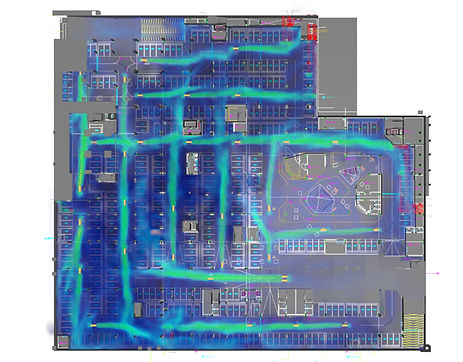
Computational Fluid Dynamics (CFD) analysis is used to design and evaluate cfd jet fan belgium distribution and ventilation systems in enclosed car parks. The simulation studies how airflow perfume in the car parking and pollutants disperse to ensure good air quality in normal mode and safe evacuation strategy. CFD analysis help engineers and designers to optimize fan locations, orientations, and exhaust points to achieve effective ventilation with less ductwork. This approach improves safety, reduces cost and ensures compliance with international standards.
.png)
CFD Simulation Analysis for Car Park Jet Fan System Belgium
CFD Projects
 |  |  |  |
|---|---|---|---|
 |  |  |  |
 |  |  |  |
 |  |  |